

South Africa has experienced a bumpy ride since the post-apartheid dawn of the “rainbow nation” in 1994. As a country, we have struggled to establish a meaningful “rainbow nation” identity, despite the time, effort and resources dedicated to this task.
Across racial and economic spectrums, discomfort is the order of the day, with so much out of control and seeming to spiral in a downwards trajectory: Debt levels, crime, education standards, access to basic services of water and electricity, transport infrastructure… the list goes on. This is exacerbated by years of negligible economic growth, and the resultant impoverished job market, resulting in few South Africans finding meaningful jobs.
As South Africans look upon the fruit that has been harvested since the establishment of the new democracy, it is easy to feel disillusioned. As you contemplate the fruits of your own labour as a South African, perhaps you are faced with notions of bad fruit, fruit shortages or even stolen fruit.
We recognise the many unavoidable and painful realities that lie ahead. We are frustrated by the meagre harvest, which fails to provide for the needs of our communities. We are looking for answers to explain this country’s inability to realize the fertile potential locked up within its borders and people. There is a sense that we are rudderless and have failed to embody the national identity which once brought hope and promise of a better future.
It’s clear that something needs to change. Instead of blaming past injustices and mystical neo-colonial forces, we need to explore alternative paths to transform our socio-economic trajectory. One way to do this is by evaluating our rainbow of cultures and the impact they have on our society. The change we require has to start deep down, from within. Chuck Palahniuk, author of the iconic book Fight Club [1], once said:
“The first step to controlling your world is to control your culture. To model and demonstrate the kind of world you demand to live in.“
CULTURE IS MULTI-DIMENSIONAL
As humans, we naturally gravitate towards communities for a variety of reasons. Whether it’s our shared biological gene pool, common interests, or benefits such as safety and economic opportunity, all communities have a unique culture. Over time, communities who work, live or play together develop a unique, programmable code that defines who they are and what they do. If you want to control or communicate within a culture, you have to understand it’s code. At its most simple, culture can be defined as “this is how we do things here.”
However, culture is also complex, as all cultures are multi-dimensional, structured and dynamic. For the purposes of following discussions, the definition of culture will be accepted as defined by Edgar Schein, as contained in the book “Reframing Organizational Culture”[2]. Shein starts off by explaining the multi-dimensional aspect of culture by defining three distinct levels using an iceberg as a metaphor. But a floating iceberg is a foreign concept to us living on the southern tip of Africa, and perhaps a more relevant metaphor, within the African context, is that of a fruit tree. Observing the elements of a fruit tree, the same metaphor for culture can be applied.
For the purposes of this article, we can think of Artefacts, as being represented by the visible part of the iceberg or the fruit of the tree; Espoused Values, being the somewhat hidden level of the iceberg, or the trunk of the tree, and Basic Assumptions, laying deep below the water or, like the roots below the earth’s surface, are hidden from plain sight. When using the metaphor of a tree, we can also add another dimension to the description of culture through its branches.
- Artefacts are the visible and tangible aspects of a culture. That part of the ice-berg that is visible above the water level. This level incorporates the visible structures and processes of a group or organization, their physical space, and behaviours. Artefacts may include dress, food, and architecture. These are the things that we can observe and easily identify as part of a certain culture.
- Branches are what the fruit grows from and clings to. In a group, the choices made are the branches that bear the fruit. The quality of decision making will be determined by the culture’s espoused values. Bad choices result in bad fruit, good choices in good fruit. The artefacts are visible based on the choices that each group makes collectively.
For someone to understand these visible cultural artefacts, we need to look below the waterline, to the next level. We need to recognise what is channelling the food to the branches and ultimately allowing fruit to develop.
- Espoused Values are the stated beliefs, values, and norms of a culture. These are the ideals and goals that a culture aspires to, as well as the strategies and core philosophies which they adopt. Espoused values are the dominant influence shaping the decisions and actions taken by an organization, although they may or may not align with the actual behaviour of individuals within the culture.
Feeding this level is an even deeper level, which can be difficult to identify, that forms the foundation of culture. Like the roots of a tree, the nutrients which feed the fruit come from deep within.
- Basic Assumptions are the underlying, often unconscious, belief system, perceptions and values that drive behaviour within a culture. They show up in thoughts and feelings that are often taken for granted, and rarely questioned, in the group. The basic assumptions of any culture inform the worldview of individuals, which in turn create a collective belief system.
- Oxford Reference gives the meaning of “worldview” as: “A largely unconscious but generally coherent set of presuppositions and beliefs that a person has which shape how they make sense of the world and everything in it“. In other words, a person’s worldview can be defined as the lens though which their world is viewed, interpreted and explained. A person’s worldview is their mental model of reality and informs their mindset, the way they think about, and respond to their world. Careful observation is required over time, if you really want to understand the foundation upon which an organization’s culture is built.
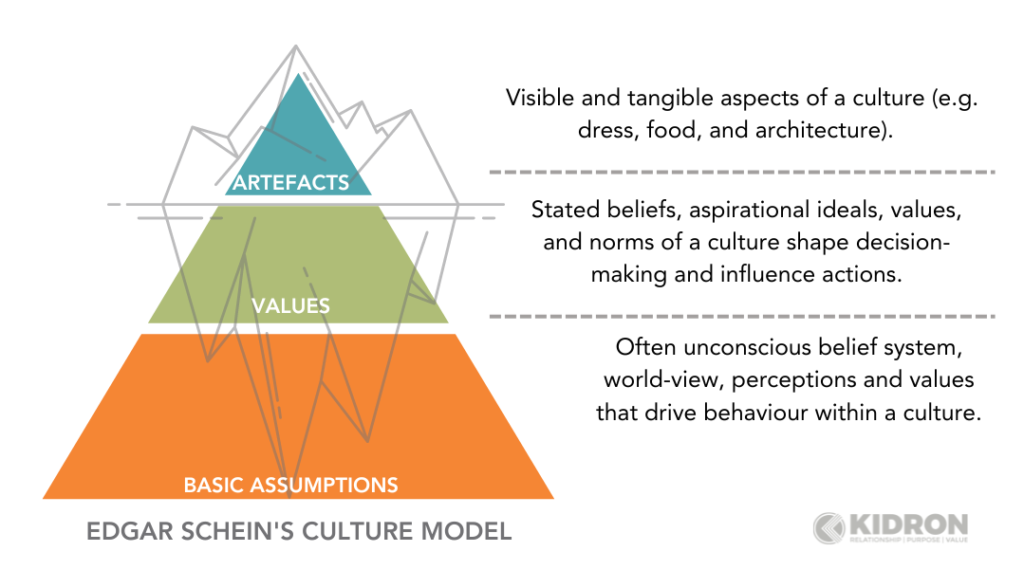
Ultimately, any culture is founded on a set of basic assumptions which defines the culture’s ordinary world comprising of espoused values, decisions and visible artefacts (fruit). In order to understand or change the “artefacts” of a culture, you need to address the culture’s code by going down below the water-line to a deeper level of understanding.
Furthermore, much like icebergs colliding out at sea, when cultures integrate, the contact occurs somewhere below the surface. Meaningful collaboration and relationships between different cultures is only possible where there is sufficient overlap of their respective basic assumptions. To navigate such a collision, we need leadership, skill, and time to truly understand and respect respective cultural codes.
CONCLUSION
The choices made by leaders, the policies adopted, are the structures which determine which fruit will be harvested by a culture. These choices are driven by espoused values, which are ultimately rooted in the basic assumptions or worldview held by the culture.
As individuals, our identity is shaped by the culture we are a part of – whether it be at home, work, or play. Our culture defines our ordinary world and has a significant impact on the quality of the results we produce.
To achieve different outcomes, we must examine and potentially shift our culture. As Palahniuk and Schein have noted, changing the artefacts (fruit) of a culture requires a deeper understanding and transformation of the cultural code that underpin it. By doing so, we can create a more positive and productive environment for ourselves and those around us.
REFERENCES
- Palahniuk, C(2004). The first step — especially for young people with energy and drive and talent, but not money — the first step to controlling your world is to control your culture. To model and demonstrate the kind of world you demand to live in. To write the books. Make the music. Shoot the films. Paint the art. Closing remarks made on an eClass forum (Barnes & Noble University) (2004-12-05)
- Schein, E.H. (1991). What is Culture? In P.J. Frost, J. Martin, L.F. Moore, CC Lundberg, & M.R. Louis, (Eds.), Reframing Organizational Culture. SAGE Publications, Newbury Park, California 93120 (pp. 243-253).
Leave a Reply